
Our In-House Cannabinoid Medicine Specialist
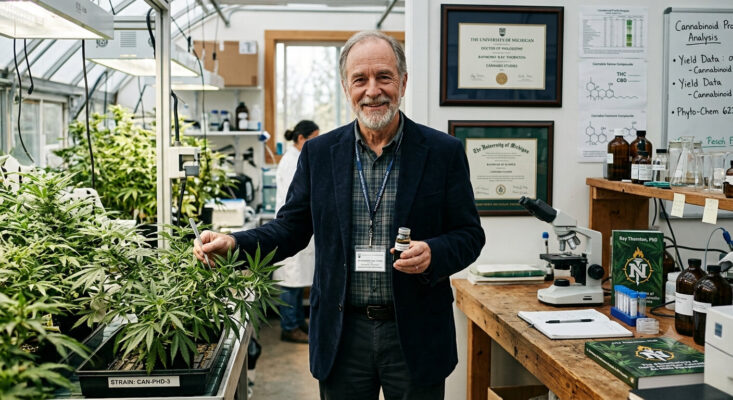
Dr. Ray Thornton B.Eng., PhD
Dr. Ray Thornton is our leading in-house expert in cannabinoid medicine, bringing over three decades of academic rigor, research, and deep industry knowledge to our team. A pioneer in the study of cannabis, Ray has dedicated his career to demystifying the plant and advancing the science behind its therapeutic and practical applications.
Ray’s journey began at Northern Michigan University, where he earned his foundational degrees and first cultivated his passion for plant genetics and botanical chemistry. Driven by a desire to understand the complex interactions between cannabinoids and the human body, he went on to earn a pioneering PhD in Cannabis Studies, cementing his place as a leading authority in the field.
At the lab, Dr. Thornton bridges the gap between cutting-edge laboratory science and everyday consumer education. Whether he is analyzing cannabinoid profiles, evaluating the efficacy of new hardware, or diving deep into the nuances of dry herb chemistry, Ray ensures that our standards remain unmatched. His rare blend of academic excellence and accessible expertise makes him an invaluable asset to our mission and a trusted guide for our community.
“Understanding cannabis isn’t just about the science of the plant; it’s about respecting its history, mastering its chemistry, and safely unlocking its true potential.” — Dr. Ray Thornton
In the Lab with Dr. Ray Thornton: A Q&A on Cannabis Vaporization
Q: From a scientific standpoint, what is actually happening when someone uses a dry herb vaporizer versus traditional combustion?
Dr. Thornton: “It all comes down to temperature control and boiling points. When you burn cannabis with a lighter, temperatures easily exceed 600°C to 900°C. This causes combustion, which destroys a massive percentage of the cannabinoids and terpenes before you even inhale them, replacing them with smoke, ash, and tar.
Vaporization, on the other hand, relies on convection or conduction heating to precisely raise the temperature of the flower—usually between 180°C and 220°C. This is hot enough to boil and aerosolize the active compounds into a clean vapor, but cool enough to avoid ignition. You are essentially boiling off the trichomes while leaving the plant matter intact.”
Q: There is a lot of debate between conduction and convection heating. What’s the practical difference for the user?
Dr. Thornton: “Think of conduction like cooking on a frying pan; the cannabis material directly touches a heated surface (usually a ceramic or stainless steel oven). It heats up fast and gives you thick clouds right away, but you need to stir it occasionally to ensure an even bake.
Convection is more like an air fryer. Hot air is pulled through the flower only when you inhale. It takes a little longer to heat up, but it offers vastly superior flavor preservation and an incredibly even extraction because the heat surrounds the herb uniformly.”
Q: Some users complain that switching from smoking to vaping doesn’t give them the same heavy “kick.” Why is that?
Dr. Thornton: “That ‘kick’ or immediate heaviness from smoking is often a physiological response to oxygen deprivation and the inhalation of toxic combustion byproducts like carbon monoxide and benzene—not the cannabis itself.
When you vape, you are experiencing a much cleaner, ‘pure’ cannabinoid profile. It can feel like a clearer-headed, uplifting experience initially because your body isn’t fighting off smoke toxins. If you are looking for a heavier effect from a vaporizer, I recommend bumping the temperature up to the higher end of the spectrum (around 210°C to 220°C) to ensure you are fully extracting higher-boiling-point cannabinoids like CBD and CBN.”
Q: As an expert, what are the most important factors someone should look for when choosing a high-quality vaporizer?
Dr. Thornton: “First and foremost is the isolated vapor path. You want to ensure that the air you breathe does not pass over internal electronics, wires, or cheap plastics, which can off-gas at high temperatures. Look for medical-grade materials like ceramic, quartz, zirconia, or stainless steel.
Second is precise temperature control. Preset heat settings are fine for beginners, but a device that lets you adjust the temperature degree-by-degree allows you to target specific terpenes and cannabinoids to customize your experience.”
Q: What is your absolute number one tip for maintaining a vaporizer’s performance?
Dr. Thornton: “Cleanliness is paramount. Residual oils and resin build up quickly, which restricts airflow and ruins the flavor profile of high-quality flower. A quick brush of the oven while it’s still warm, followed by a regular soak of the mouthpiece and screens in high-percentage isopropyl alcohol, will keep your device performing like it’s brand new.”
Learn more about Dr. Thornton commentaries on vaporizers sold by City Vaporizer: